Choose a decision representation
Goal: choose operators that preserve the meaning of a decision, then verify the returned domains. Complete T01 first and install the coverage environment. Real-valued ZDT1 is already covered by T01; the four examples below use NSGA-II, NumPy, seed 42, population/offspring 40 and 400 evaluations each.
The problem catalogue defines the built-ins, and the problem protocol defines bounds, encoding and mixed-variable metadata. An array’s floating dtype does not make a discrete variable continuous. The script checks values and bounds, rather than inferring validity from dtype.
Binary masks
zdt5 uses 80 binary decisions in its default formulation. Uniform crossover exchanges bit choices; bit-flip mutation changes them. ZDT5 is a synthetic optimization problem, not a feature-selection model.
python binary.py
python binary.py --output binary-local.svg
Complete runnable script
"""Verified VAMOS 1.0.1 lesson: binary. See coverage-setup for dependencies."""


def execute_example(problem, algorithm, config, budget, seed=42, engine="numpy"):
    import numpy as np

    from vamos import OptimizationResult, optimize

    result = optimize(problem, algorithm=algorithm, algorithm_config=config, max_evaluations=budget, seed=seed, engine=engine)
    G = result.data.get("G")
    if getattr(problem, "n_constraints", 0) and G is None:
        raise ValueError("Declared constraints are missing from the returned result.")
    feasible_rows = np.arange(len(result.F)) if G is None else np.flatnonzero(np.all(G <= 0, axis=1))
    if len(feasible_rows):
        feasible = OptimizationResult({"X": result.X[feasible_rows], "F": result.F[feasible_rows]})
        front, local = feasible.front(return_indices=True)
        front_rows = feasible_rows[local]
    else:
        front, front_rows = np.empty((0, problem.n_obj)), np.empty(0, dtype=int)
    print(f"Algorithm: {algorithm}; encoding: {problem.encoding}; backend: {engine}; seed: {seed}")
    print(f"Returned X: {result.X.shape}; F: {result.F.shape}; result mode: population")
    print(f"Feasible rows: {len(feasible_rows)}/{len(result.F)}; feasible non-dominated rows: {len(front)}")
    print(f"Evaluations: {result.data['evaluations']}")
    return {
        "problem": problem,
        "algorithm": algorithm,
        "config": config,
        "result": result,
        "feasible_rows": feasible_rows,
        "front": front,
        "front_rows": front_rows,
    }


def run_encoding(encoding="binary", budget=400):
    import numpy as np

    from vamos import make_problem_selection
    from vamos.algorithms import NSGAIIConfig

    choices = {
        "binary": ("zdt5", "uniform", "bitflip"),
        "integer": ("int_alloc", "uniform", "reset"),
        "permutation": ("tsp6", "ox", "swap"),
        "mixed": ("mixed_design", "mixed", "mixed"),
    }
    name, crossover, mutation = choices[encoding]
    problem = make_problem_selection(name).instantiate()
    config = (
        NSGAIIConfig.builder()
        .pop_size(40)
        .offspring_size(40)
        .crossover(crossover, prob=0.9)
        .mutation(mutation, prob=1.0 / problem.n_var)
        .selection("tournament", size=2)
        .result_mode("population")
        .build()
    )
    data = execute_example(problem, "nsgaii", config, budget)
    x = data["result"].X
    if encoding == "binary":
        valid = np.isin(x, [0, 1]).all()
    elif encoding == "permutation":
        valid = (np.sort(x, axis=1) == np.arange(problem.n_var)).all()
    else:
        discrete = (
            np.arange(problem.n_var)
            if encoding == "integer"
            else np.concatenate([problem.mixed_spec["int_idx"], problem.mixed_spec["cat_idx"]])
        )
        valid = np.equal(x[:, discrete], np.rint(x[:, discrete])).all()
    valid = bool(valid and np.all(x >= problem.xl) and np.all(x <= problem.xu))
    if not valid:
        raise ValueError("Returned decisions violate the representation's domains.")
    print(f"Domain checks: passed for {encoding}")
    return data


def plot_example(data, output):
    from pathlib import Path

    import matplotlib

    matplotlib.use("Agg")
    import matplotlib.pyplot as plt
    import numpy as np

    output = Path(output)
    if output.exists():
        raise FileExistsError(f"Choose a new figure filename: {output}")
    if output.suffix.lower() != ".svg":
        raise ValueError("Use an .svg output filename.")
    f = data["result"].F
    with plt.rc_context({"svg.hashsalt": "vamos-coverage", "svg.fonttype": "none"}):
        fig = plt.figure(figsize=(7, 4.5), layout="constrained")
        if f.shape[1] == 3:
            ax = fig.add_subplot(projection="3d")
            ax.scatter(*f.T, c="#007f7a", s=22)
            ax.set(xlabel="f1", ylabel="f2", zlabel="f3")
            ax.set_box_aspect((1, 1, 0.85), zoom=0.85)
        else:
            ax = fig.add_subplot()
            ax.scatter(*f.T, c="#b6bec8", s=25, label="Returned population")
            if len(data["front"]):
                ax.scatter(*data["front"].T, c="#007f7a", s=30, label="Feasible non-dominated rows")
            labels = {
                "WeldedBeamDesignProblem": ("Cost (minimize)", "Deflection proxy (minimize)"),
                "FeatureSelectionProblem": ("Validation error (minimize)", "Feature count (minimize)"),
                "HyperparameterTuningProblem": ("Validation error (minimize)", "Complexity proxy (minimize)"),
            }
            xlabel, ylabel = labels.get(type(data["problem"]).__name__, ("f1 (minimize)", "f2 (minimize)"))
            ax.set(xlabel=xlabel, ylabel=ylabel)
            ax.legend()
        if data["problem"].__class__.__name__ in {"ZDT1", "ZDT1Problem"}:
            x = np.linspace(0, 1, 101)
            ax.plot(x, 1 - np.sqrt(x), "--", c="#7c8795", label="Analytical front")
            ax.legend()
        ax.set_title(f"{data['algorithm'].upper()} · {data['result'].data['evaluations']} evaluations · seed 42")
        fig.savefig(output, metadata={"Date": None}, bbox_inches="tight", pad_inches=0.25)
        plt.close(fig)
    output.write_text("\n".join(line.rstrip() for line in output.read_text(encoding="utf-8").splitlines()) + "\n", encoding="utf-8")


def lesson_cli(function, default_budget=400):
    import argparse

    parser = argparse.ArgumentParser(description="Run a bounded VAMOS example and optionally plot its actual result.")
    parser.add_argument("--budget", type=int, default=default_budget)
    parser.add_argument("--output", help="New SVG filename; requires Matplotlib")
    args = parser.parse_args()
    data = function(budget=args.budget)
    if args.output:
        plot_example(data, args.output)


def run_lesson(budget=400):
    return run_encoding("binary", budget)


if __name__ == "__main__":
    lesson_cli(run_lesson, default_budget=400)
Recorded output
Algorithm: nsgaii; encoding: binary; backend: numpy; seed: 42
Returned X: (40, 80); F: (40, 2); result mode: population
Feasible rows: 40/40; feasible non-dominated rows: 14
Evaluations: 400
Domain checks: passed for binary
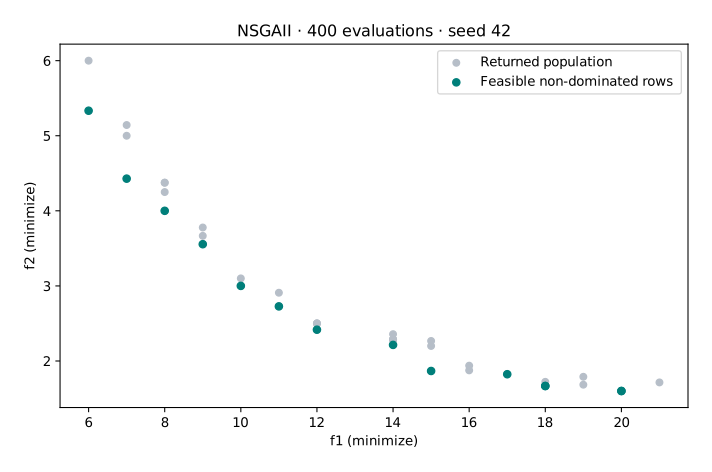
Measured with VAMOS 1.0.1; the observations and provenance retain the inputs and results.
Every returned entry must be 0 or 1. The nominal mutation probability is 1/n_var; a binary representation needs more than rounding the output of a real-valued operator.
Try one change: increase the budget to 800 without changing the representation, operators or seed. Check domain validity again before interpreting any objective improvement.
Bounded integers
int_alloc uses 20 integer decisions by default. Uniform crossover and reset mutation preserve the discrete allocation domains.
python integer.py
python integer.py --output integer-local.svg
Complete runnable script
"""Verified VAMOS 1.0.1 lesson: integer. See coverage-setup for dependencies."""


def execute_example(problem, algorithm, config, budget, seed=42, engine="numpy"):
    import numpy as np

    from vamos import OptimizationResult, optimize

    result = optimize(problem, algorithm=algorithm, algorithm_config=config, max_evaluations=budget, seed=seed, engine=engine)
    G = result.data.get("G")
    if getattr(problem, "n_constraints", 0) and G is None:
        raise ValueError("Declared constraints are missing from the returned result.")
    feasible_rows = np.arange(len(result.F)) if G is None else np.flatnonzero(np.all(G <= 0, axis=1))
    if len(feasible_rows):
        feasible = OptimizationResult({"X": result.X[feasible_rows], "F": result.F[feasible_rows]})
        front, local = feasible.front(return_indices=True)
        front_rows = feasible_rows[local]
    else:
        front, front_rows = np.empty((0, problem.n_obj)), np.empty(0, dtype=int)
    print(f"Algorithm: {algorithm}; encoding: {problem.encoding}; backend: {engine}; seed: {seed}")
    print(f"Returned X: {result.X.shape}; F: {result.F.shape}; result mode: population")
    print(f"Feasible rows: {len(feasible_rows)}/{len(result.F)}; feasible non-dominated rows: {len(front)}")
    print(f"Evaluations: {result.data['evaluations']}")
    return {
        "problem": problem,
        "algorithm": algorithm,
        "config": config,
        "result": result,
        "feasible_rows": feasible_rows,
        "front": front,
        "front_rows": front_rows,
    }


def run_encoding(encoding="binary", budget=400):
    import numpy as np

    from vamos import make_problem_selection
    from vamos.algorithms import NSGAIIConfig

    choices = {
        "binary": ("zdt5", "uniform", "bitflip"),
        "integer": ("int_alloc", "uniform", "reset"),
        "permutation": ("tsp6", "ox", "swap"),
        "mixed": ("mixed_design", "mixed", "mixed"),
    }
    name, crossover, mutation = choices[encoding]
    problem = make_problem_selection(name).instantiate()
    config = (
        NSGAIIConfig.builder()
        .pop_size(40)
        .offspring_size(40)
        .crossover(crossover, prob=0.9)
        .mutation(mutation, prob=1.0 / problem.n_var)
        .selection("tournament", size=2)
        .result_mode("population")
        .build()
    )
    data = execute_example(problem, "nsgaii", config, budget)
    x = data["result"].X
    if encoding == "binary":
        valid = np.isin(x, [0, 1]).all()
    elif encoding == "permutation":
        valid = (np.sort(x, axis=1) == np.arange(problem.n_var)).all()
    else:
        discrete = (
            np.arange(problem.n_var)
            if encoding == "integer"
            else np.concatenate([problem.mixed_spec["int_idx"], problem.mixed_spec["cat_idx"]])
        )
        valid = np.equal(x[:, discrete], np.rint(x[:, discrete])).all()
    valid = bool(valid and np.all(x >= problem.xl) and np.all(x <= problem.xu))
    if not valid:
        raise ValueError("Returned decisions violate the representation's domains.")
    print(f"Domain checks: passed for {encoding}")
    return data


def plot_example(data, output):
    from pathlib import Path

    import matplotlib

    matplotlib.use("Agg")
    import matplotlib.pyplot as plt
    import numpy as np

    output = Path(output)
    if output.exists():
        raise FileExistsError(f"Choose a new figure filename: {output}")
    if output.suffix.lower() != ".svg":
        raise ValueError("Use an .svg output filename.")
    f = data["result"].F
    with plt.rc_context({"svg.hashsalt": "vamos-coverage", "svg.fonttype": "none"}):
        fig = plt.figure(figsize=(7, 4.5), layout="constrained")
        if f.shape[1] == 3:
            ax = fig.add_subplot(projection="3d")
            ax.scatter(*f.T, c="#007f7a", s=22)
            ax.set(xlabel="f1", ylabel="f2", zlabel="f3")
            ax.set_box_aspect((1, 1, 0.85), zoom=0.85)
        else:
            ax = fig.add_subplot()
            ax.scatter(*f.T, c="#b6bec8", s=25, label="Returned population")
            if len(data["front"]):
                ax.scatter(*data["front"].T, c="#007f7a", s=30, label="Feasible non-dominated rows")
            labels = {
                "WeldedBeamDesignProblem": ("Cost (minimize)", "Deflection proxy (minimize)"),
                "FeatureSelectionProblem": ("Validation error (minimize)", "Feature count (minimize)"),
                "HyperparameterTuningProblem": ("Validation error (minimize)", "Complexity proxy (minimize)"),
            }
            xlabel, ylabel = labels.get(type(data["problem"]).__name__, ("f1 (minimize)", "f2 (minimize)"))
            ax.set(xlabel=xlabel, ylabel=ylabel)
            ax.legend()
        if data["problem"].__class__.__name__ in {"ZDT1", "ZDT1Problem"}:
            x = np.linspace(0, 1, 101)
            ax.plot(x, 1 - np.sqrt(x), "--", c="#7c8795", label="Analytical front")
            ax.legend()
        ax.set_title(f"{data['algorithm'].upper()} · {data['result'].data['evaluations']} evaluations · seed 42")
        fig.savefig(output, metadata={"Date": None}, bbox_inches="tight", pad_inches=0.25)
        plt.close(fig)
    output.write_text("\n".join(line.rstrip() for line in output.read_text(encoding="utf-8").splitlines()) + "\n", encoding="utf-8")


def lesson_cli(function, default_budget=400):
    import argparse

    parser = argparse.ArgumentParser(description="Run a bounded VAMOS example and optionally plot its actual result.")
    parser.add_argument("--budget", type=int, default=default_budget)
    parser.add_argument("--output", help="New SVG filename; requires Matplotlib")
    args = parser.parse_args()
    data = function(budget=args.budget)
    if args.output:
        plot_example(data, args.output)


def run_lesson(budget=400):
    return run_encoding("integer", budget)


if __name__ == "__main__":
    lesson_cli(run_lesson, default_budget=400)
Recorded output
Algorithm: nsgaii; encoding: integer; backend: numpy; seed: 42
Returned X: (40, 20); F: (40, 2); result mode: population
Feasible rows: 40/40; feasible non-dominated rows: 40
Evaluations: 400
Domain checks: passed for integer
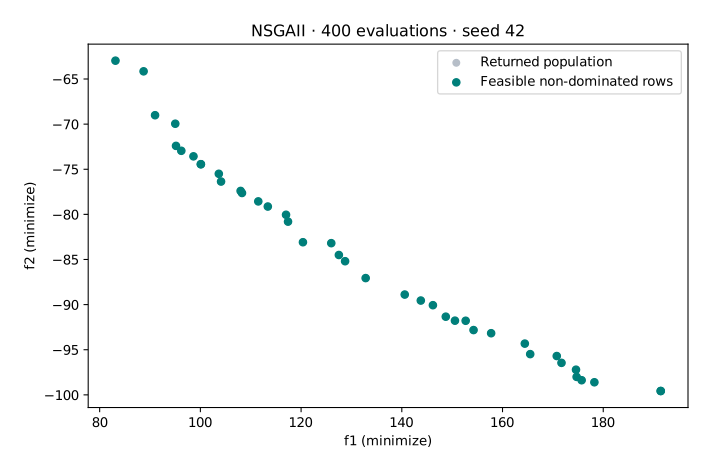
Measured with VAMOS 1.0.1; the observations and provenance retain the inputs and results.
All values must be integral and within the declared bounds. Domain validity does not by itself enforce any additional resource constraints you might add to your own allocation problem.
Try one change: increase the budget to 800 without changing the representation, operators or seed. Check domain validity again before interpreting any objective improvement.
Permutation routes
tsp6 uses six city indices in a route permutation. Order crossover (ox) and swap mutation preserve membership and uniqueness.
python permutation.py
python permutation.py --output permutation-local.svg
Complete runnable script
"""Verified VAMOS 1.0.1 lesson: permutation. See coverage-setup for dependencies."""


def execute_example(problem, algorithm, config, budget, seed=42, engine="numpy"):
    import numpy as np

    from vamos import OptimizationResult, optimize

    result = optimize(problem, algorithm=algorithm, algorithm_config=config, max_evaluations=budget, seed=seed, engine=engine)
    G = result.data.get("G")
    if getattr(problem, "n_constraints", 0) and G is None:
        raise ValueError("Declared constraints are missing from the returned result.")
    feasible_rows = np.arange(len(result.F)) if G is None else np.flatnonzero(np.all(G <= 0, axis=1))
    if len(feasible_rows):
        feasible = OptimizationResult({"X": result.X[feasible_rows], "F": result.F[feasible_rows]})
        front, local = feasible.front(return_indices=True)
        front_rows = feasible_rows[local]
    else:
        front, front_rows = np.empty((0, problem.n_obj)), np.empty(0, dtype=int)
    print(f"Algorithm: {algorithm}; encoding: {problem.encoding}; backend: {engine}; seed: {seed}")
    print(f"Returned X: {result.X.shape}; F: {result.F.shape}; result mode: population")
    print(f"Feasible rows: {len(feasible_rows)}/{len(result.F)}; feasible non-dominated rows: {len(front)}")
    print(f"Evaluations: {result.data['evaluations']}")
    return {
        "problem": problem,
        "algorithm": algorithm,
        "config": config,
        "result": result,
        "feasible_rows": feasible_rows,
        "front": front,
        "front_rows": front_rows,
    }


def run_encoding(encoding="binary", budget=400):
    import numpy as np

    from vamos import make_problem_selection
    from vamos.algorithms import NSGAIIConfig

    choices = {
        "binary": ("zdt5", "uniform", "bitflip"),
        "integer": ("int_alloc", "uniform", "reset"),
        "permutation": ("tsp6", "ox", "swap"),
        "mixed": ("mixed_design", "mixed", "mixed"),
    }
    name, crossover, mutation = choices[encoding]
    problem = make_problem_selection(name).instantiate()
    config = (
        NSGAIIConfig.builder()
        .pop_size(40)
        .offspring_size(40)
        .crossover(crossover, prob=0.9)
        .mutation(mutation, prob=1.0 / problem.n_var)
        .selection("tournament", size=2)
        .result_mode("population")
        .build()
    )
    data = execute_example(problem, "nsgaii", config, budget)
    x = data["result"].X
    if encoding == "binary":
        valid = np.isin(x, [0, 1]).all()
    elif encoding == "permutation":
        valid = (np.sort(x, axis=1) == np.arange(problem.n_var)).all()
    else:
        discrete = (
            np.arange(problem.n_var)
            if encoding == "integer"
            else np.concatenate([problem.mixed_spec["int_idx"], problem.mixed_spec["cat_idx"]])
        )
        valid = np.equal(x[:, discrete], np.rint(x[:, discrete])).all()
    valid = bool(valid and np.all(x >= problem.xl) and np.all(x <= problem.xu))
    if not valid:
        raise ValueError("Returned decisions violate the representation's domains.")
    print(f"Domain checks: passed for {encoding}")
    return data


def plot_example(data, output):
    from pathlib import Path

    import matplotlib

    matplotlib.use("Agg")
    import matplotlib.pyplot as plt
    import numpy as np

    output = Path(output)
    if output.exists():
        raise FileExistsError(f"Choose a new figure filename: {output}")
    if output.suffix.lower() != ".svg":
        raise ValueError("Use an .svg output filename.")
    f = data["result"].F
    with plt.rc_context({"svg.hashsalt": "vamos-coverage", "svg.fonttype": "none"}):
        fig = plt.figure(figsize=(7, 4.5), layout="constrained")
        if f.shape[1] == 3:
            ax = fig.add_subplot(projection="3d")
            ax.scatter(*f.T, c="#007f7a", s=22)
            ax.set(xlabel="f1", ylabel="f2", zlabel="f3")
            ax.set_box_aspect((1, 1, 0.85), zoom=0.85)
        else:
            ax = fig.add_subplot()
            ax.scatter(*f.T, c="#b6bec8", s=25, label="Returned population")
            if len(data["front"]):
                ax.scatter(*data["front"].T, c="#007f7a", s=30, label="Feasible non-dominated rows")
            labels = {
                "WeldedBeamDesignProblem": ("Cost (minimize)", "Deflection proxy (minimize)"),
                "FeatureSelectionProblem": ("Validation error (minimize)", "Feature count (minimize)"),
                "HyperparameterTuningProblem": ("Validation error (minimize)", "Complexity proxy (minimize)"),
            }
            xlabel, ylabel = labels.get(type(data["problem"]).__name__, ("f1 (minimize)", "f2 (minimize)"))
            ax.set(xlabel=xlabel, ylabel=ylabel)
            ax.legend()
        if data["problem"].__class__.__name__ in {"ZDT1", "ZDT1Problem"}:
            x = np.linspace(0, 1, 101)
            ax.plot(x, 1 - np.sqrt(x), "--", c="#7c8795", label="Analytical front")
            ax.legend()
        ax.set_title(f"{data['algorithm'].upper()} · {data['result'].data['evaluations']} evaluations · seed 42")
        fig.savefig(output, metadata={"Date": None}, bbox_inches="tight", pad_inches=0.25)
        plt.close(fig)
    output.write_text("\n".join(line.rstrip() for line in output.read_text(encoding="utf-8").splitlines()) + "\n", encoding="utf-8")


def lesson_cli(function, default_budget=400):
    import argparse

    parser = argparse.ArgumentParser(description="Run a bounded VAMOS example and optionally plot its actual result.")
    parser.add_argument("--budget", type=int, default=default_budget)
    parser.add_argument("--output", help="New SVG filename; requires Matplotlib")
    args = parser.parse_args()
    data = function(budget=args.budget)
    if args.output:
        plot_example(data, args.output)


def run_lesson(budget=400):
    return run_encoding("permutation", budget)


if __name__ == "__main__":
    lesson_cli(run_lesson, default_budget=400)
Recorded output
Algorithm: nsgaii; encoding: permutation; backend: numpy; seed: 42
Returned X: (40, 6); F: (40, 2); result mode: population
Feasible rows: 40/40; feasible non-dominated rows: 40
Evaluations: 400
Domain checks: passed for permutation
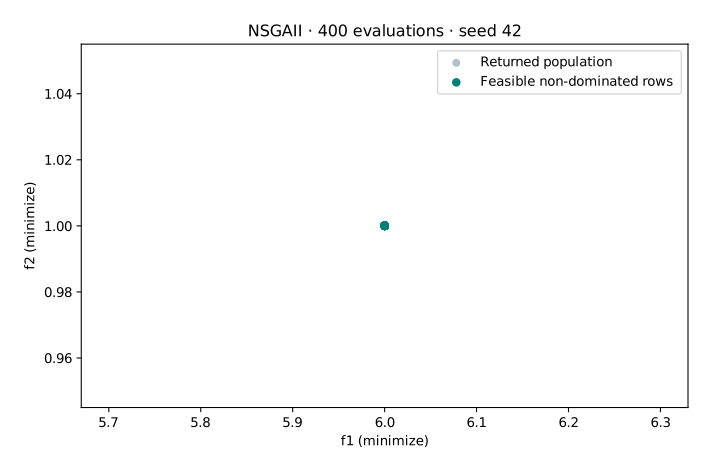
Measured with VAMOS 1.0.1; the observations and provenance retain the inputs and results.
Every row must sort to 0, 1, 2, 3, 4, 5. The built-in objective closes the route; appending the starting city to the decision vector would violate the representation. The toy multiobjective route is not a production routing model. In the recorded run, all returned objective vectors coincide at [6, 1]; overlapping points appear as one dot. Multiple rows and permutations need not represent distinct trade-offs.
Try one change: increase the budget to 800 without changing the representation, operators or seed. Check domain validity again before interpreting any objective improvement.
Mixed designs
mixed_design combines three real, three integer and three categorical variables. Mixed variation uses problem.mixed_spec to select appropriate behavior for each group.
python mixed.py
python mixed.py --output mixed-local.svg
Complete runnable script
"""Verified VAMOS 1.0.1 lesson: mixed. See coverage-setup for dependencies."""


def execute_example(problem, algorithm, config, budget, seed=42, engine="numpy"):
    import numpy as np

    from vamos import OptimizationResult, optimize

    result = optimize(problem, algorithm=algorithm, algorithm_config=config, max_evaluations=budget, seed=seed, engine=engine)
    G = result.data.get("G")
    if getattr(problem, "n_constraints", 0) and G is None:
        raise ValueError("Declared constraints are missing from the returned result.")
    feasible_rows = np.arange(len(result.F)) if G is None else np.flatnonzero(np.all(G <= 0, axis=1))
    if len(feasible_rows):
        feasible = OptimizationResult({"X": result.X[feasible_rows], "F": result.F[feasible_rows]})
        front, local = feasible.front(return_indices=True)
        front_rows = feasible_rows[local]
    else:
        front, front_rows = np.empty((0, problem.n_obj)), np.empty(0, dtype=int)
    print(f"Algorithm: {algorithm}; encoding: {problem.encoding}; backend: {engine}; seed: {seed}")
    print(f"Returned X: {result.X.shape}; F: {result.F.shape}; result mode: population")
    print(f"Feasible rows: {len(feasible_rows)}/{len(result.F)}; feasible non-dominated rows: {len(front)}")
    print(f"Evaluations: {result.data['evaluations']}")
    return {
        "problem": problem,
        "algorithm": algorithm,
        "config": config,
        "result": result,
        "feasible_rows": feasible_rows,
        "front": front,
        "front_rows": front_rows,
    }


def run_encoding(encoding="binary", budget=400):
    import numpy as np

    from vamos import make_problem_selection
    from vamos.algorithms import NSGAIIConfig

    choices = {
        "binary": ("zdt5", "uniform", "bitflip"),
        "integer": ("int_alloc", "uniform", "reset"),
        "permutation": ("tsp6", "ox", "swap"),
        "mixed": ("mixed_design", "mixed", "mixed"),
    }
    name, crossover, mutation = choices[encoding]
    problem = make_problem_selection(name).instantiate()
    config = (
        NSGAIIConfig.builder()
        .pop_size(40)
        .offspring_size(40)
        .crossover(crossover, prob=0.9)
        .mutation(mutation, prob=1.0 / problem.n_var)
        .selection("tournament", size=2)
        .result_mode("population")
        .build()
    )
    data = execute_example(problem, "nsgaii", config, budget)
    x = data["result"].X
    if encoding == "binary":
        valid = np.isin(x, [0, 1]).all()
    elif encoding == "permutation":
        valid = (np.sort(x, axis=1) == np.arange(problem.n_var)).all()
    else:
        discrete = (
            np.arange(problem.n_var)
            if encoding == "integer"
            else np.concatenate([problem.mixed_spec["int_idx"], problem.mixed_spec["cat_idx"]])
        )
        valid = np.equal(x[:, discrete], np.rint(x[:, discrete])).all()
    valid = bool(valid and np.all(x >= problem.xl) and np.all(x <= problem.xu))
    if not valid:
        raise ValueError("Returned decisions violate the representation's domains.")
    print(f"Domain checks: passed for {encoding}")
    return data


def plot_example(data, output):
    from pathlib import Path

    import matplotlib

    matplotlib.use("Agg")
    import matplotlib.pyplot as plt
    import numpy as np

    output = Path(output)
    if output.exists():
        raise FileExistsError(f"Choose a new figure filename: {output}")
    if output.suffix.lower() != ".svg":
        raise ValueError("Use an .svg output filename.")
    f = data["result"].F
    with plt.rc_context({"svg.hashsalt": "vamos-coverage", "svg.fonttype": "none"}):
        fig = plt.figure(figsize=(7, 4.5), layout="constrained")
        if f.shape[1] == 3:
            ax = fig.add_subplot(projection="3d")
            ax.scatter(*f.T, c="#007f7a", s=22)
            ax.set(xlabel="f1", ylabel="f2", zlabel="f3")
            ax.set_box_aspect((1, 1, 0.85), zoom=0.85)
        else:
            ax = fig.add_subplot()
            ax.scatter(*f.T, c="#b6bec8", s=25, label="Returned population")
            if len(data["front"]):
                ax.scatter(*data["front"].T, c="#007f7a", s=30, label="Feasible non-dominated rows")
            labels = {
                "WeldedBeamDesignProblem": ("Cost (minimize)", "Deflection proxy (minimize)"),
                "FeatureSelectionProblem": ("Validation error (minimize)", "Feature count (minimize)"),
                "HyperparameterTuningProblem": ("Validation error (minimize)", "Complexity proxy (minimize)"),
            }
            xlabel, ylabel = labels.get(type(data["problem"]).__name__, ("f1 (minimize)", "f2 (minimize)"))
            ax.set(xlabel=xlabel, ylabel=ylabel)
            ax.legend()
        if data["problem"].__class__.__name__ in {"ZDT1", "ZDT1Problem"}:
            x = np.linspace(0, 1, 101)
            ax.plot(x, 1 - np.sqrt(x), "--", c="#7c8795", label="Analytical front")
            ax.legend()
        ax.set_title(f"{data['algorithm'].upper()} · {data['result'].data['evaluations']} evaluations · seed 42")
        fig.savefig(output, metadata={"Date": None}, bbox_inches="tight", pad_inches=0.25)
        plt.close(fig)
    output.write_text("\n".join(line.rstrip() for line in output.read_text(encoding="utf-8").splitlines()) + "\n", encoding="utf-8")


def lesson_cli(function, default_budget=400):
    import argparse

    parser = argparse.ArgumentParser(description="Run a bounded VAMOS example and optionally plot its actual result.")
    parser.add_argument("--budget", type=int, default=default_budget)
    parser.add_argument("--output", help="New SVG filename; requires Matplotlib")
    args = parser.parse_args()
    data = function(budget=args.budget)
    if args.output:
        plot_example(data, args.output)


def run_lesson(budget=400):
    return run_encoding("mixed", budget)


if __name__ == "__main__":
    lesson_cli(run_lesson, default_budget=400)
Recorded output
Algorithm: nsgaii; encoding: mixed; backend: numpy; seed: 42
Returned X: (40, 9); F: (40, 2); result mode: population
Feasible rows: 40/40; feasible non-dominated rows: 17
Evaluations: 400
Domain checks: passed for mixed
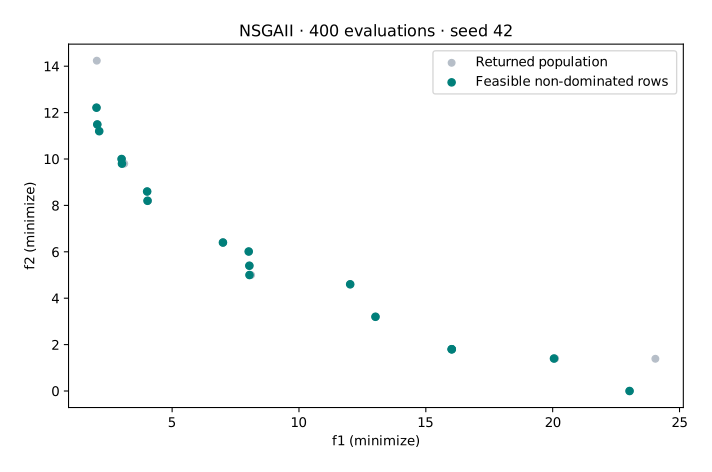
Measured with VAMOS 1.0.1; the observations and provenance retain the inputs and results.
Integer and category columns must remain discrete, and all columns must remain within bounds. Category indices represent alternatives, not an ordinal numeric preference; define their meaning in the evaluator.
Try one change: increase the budget to 800 without changing the representation, operators or seed. Check domain validity again before interpreting any objective improvement.
Choose an algorithm after the representation
The capability matrix describes supported paths; these four lessons verify one NSGA-II configuration per representation, not every algorithm/operator combination. In particular, standalone binary, integer and permutation inputs are not supported by SMPSO. Explicit real-coded defaults do not automatically become discrete operators.
Next: use feature selection for meaningful binary masks, or engineering design to combine mixed decisions and feasibility. Preserve row alignment when mapping an objective-space candidate back to decisions.