An experimental tuning run
Goal: run a bounded algorithm-configuration search and distinguish training, validation and test seeds. This workflow uses the Experimental vamos tune CLI; it does not establish a stable programmatic tuner API. Read the canonical tuning guide for the exact flags and backend behavior.
The protocol searches NSGA-II on one 10-variable ZDT1 instance with random search, two candidate trials and 400 evaluations per run. It maximizes HV with fixed reference [1.1, 11] in original objective units. The aggregate is median, training seed is 7, validation seeds are 101/102 and test seeds are 201/202. No statistical finisher is enabled.
--pop-size 20 is the CLI fallback, not a fixed search-space population: sampled candidates can choose different sizes. Candidate parameter names such as offspring_ratio belong to the tuner’s search space; do not pass best_config_raw.json directly to NSGAIIConfig as though it were a resolved algorithm configuration. The CLI translates active parameters.
Run the complete example
Prerequisites: coverage setup and T06–T08. Download the script below and choose a new output directory. The wrapper refuses an existing directory.
python tuning.py --output tuning-example
Complete runnable script
"""Verified VAMOS 1.0.1 lesson: tuning. See coverage-setup for dependencies."""


def new_output(output):
    from pathlib import Path

    path = Path(output)
    path.mkdir(parents=True, exist_ok=False)
    return path


def write_observations(output, data):
    import json

    (output / "observations.json").write_text(json.dumps(data, indent=2, allow_nan=False) + "\n", encoding="utf-8")
    return data


def run_tuning_example(output):
    import csv
    import json
    import os
    import subprocess
    import sysconfig
    from pathlib import Path

    output = new_output(output)
    command = [
        str(Path(sysconfig.get_path("scripts")) / ("vamos.exe" if os.name == "nt" else "vamos")),
        "tune",
        "--algorithm",
        "nsgaii",
        "--problem",
        "zdt1",
        "--backend",
        "random",
        "--budget",
        "400",
        "--tune-budget",
        "2",
        "--pop-size",
        "20",
        "--seed",
        "7",
        "--n-seeds",
        "1",
        "--n-jobs",
        "1",
        "--n-var",
        "10",
        "--ref-point",
        "1.1,11",
        "--aggregate-mode",
        "median",
        "--split-seed",
        "42",
        "--run-validation",
        "--run-test",
        "--validation-seeds",
        "101,102",
        "--test-seeds",
        "201,202",
        "--validation-topk",
        "1",
        "--no-run-statistical-finisher",
        "--output-dir",
        str(output),
        "--name",
        "training",
    ]
    # The CLI remains Experimental; the wrapper preserves its original artifacts.
    with (output / "console.txt").open("w", encoding="utf-8") as log:
        subprocess.run(command, stdout=log, stderr=subprocess.STDOUT, check=True)
    root = output / "training"
    summary = json.loads((root / "tuning_summary.json").read_text(encoding="utf-8"))
    history = json.loads((root / "tuning_history.json").read_text(encoding="utf-8"))
    splits = json.loads((root / "split_seeds.json").read_text(encoding="utf-8"))
    stages = {}
    for stage in ("validation", "test"):
        with (root / f"{stage}_metrics.csv").open(encoding="utf-8", newline="") as stream:
            stages[stage] = [
                {key: row[key] for key in ("score_agg", "rows_total", "rows_ok", "fail_rate")} for row in csv.DictReader(stream)
            ]
    data = {
        "kind": "tuning",
        "status": "Experimental",
        "budget_per_run": 400,
        "reference_point": [1.1, 11.0],
        "seeds": splits,
        "backend": summary["backend_effective"],
        "trials": history,
        "best_training_score": summary["best_score"],
        "stages": stages,
    }
    print(f"Experimental tuner: {data['backend']}; trials: {len(history)}; budget per run: 400")
    print(f"Best training HV: {summary['best_score']:.6f}")
    print(f"Seeds: {splits}")
    for stage, rows in stages.items():
        print(
            f"{stage}: {len(rows)} candidate summaries; successful evaluations of candidates: "
            f"{sum(int(row['rows_ok']) for row in rows)}/{sum(int(row['rows_total']) for row in rows)}"
        )
    print("The same ZDT1 instance is reused across splits; held-out seeds are not held-out problems.")
    return write_observations(output, data)


def advanced_cli(function):
    import argparse

    parser = argparse.ArgumentParser(description="Run a bounded workflow in a new output directory.")
    parser.add_argument("--output", required=True)
    args = parser.parse_args()
    function(args.output)


if __name__ == "__main__":
    advanced_cli(run_tuning_example)
Recorded output
Experimental tuner: random; trials: 2; budget per run: 400
Best training HV: 10.281806
Seeds: {'train_seeds': [7], 'validation_seeds': [101, 102], 'test_seeds': [201, 202]}
validation: 1 candidate summaries; successful evaluations of candidates: 2/2
test: 3 candidate summaries; successful evaluations of candidates: 6/6
The same ZDT1 instance is reused across splits; held-out seeds are not held-out problems.
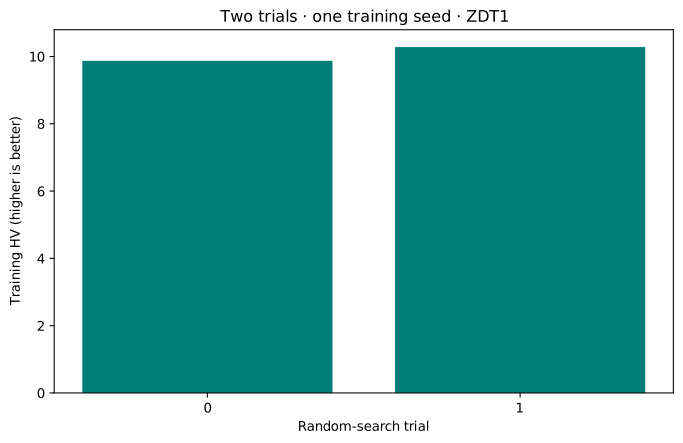
Measured with VAMOS 1.0.1; the observations and provenance retain the inputs and results.
Interpret the measurements and limits
The wrapper saves the original CLI files in training/, including best_config_raw.json, best_config_active.json, tuning_summary.json, history, split assignments, validation metrics and test metrics. It also preserves console.txt and writes a derived observations.json.
Two training trials are enough to verify the workflow, not to select a generally strong configuration. The reference point and objective formulation remain identical across stages. With only one problem instance, the split reuses that instance and holds out seeds only. The CLI reports three test champion summaries; in this small run they can refer to the same configuration. They are not three independent discoveries, and repeated test rows must not be pooled as independent evidence.
The test stage should be inspected only after the selection procedure is fixed. Iterating the search in response to its result turns it into validation feedback. The recorded figure shows training trial scores only; it does not claim generalization to unseen problems. Random search needs the core package; optional model-based backends have separate dependencies and remain Experimental.
Try one controlled change
Increase --tune-budget to four in the downloaded script while preserving the reference, split policy and final-test discipline. State that the search cost changed; compare total candidate evaluations, not just the best score.
Next: use T08 to report a prespecified experiment with its failures, assumptions and evidence. Consult stability and versioning before depending on Experimental interfaces.